 Send an email
 Call us
A Journey Through Iconic Italian Homes: From Ancient Elegance to Modern Innovation
14 May 2025

There’s no doubt that when foreigners visit Italy, 99% of the time they are astonished by the quality of Italian historical buildings. What does this mean? Are only properties from the past worth buying? Absolutely not—but to clearly understand where Italy’s construction quality comes from, let’s embark on a brief journey through the main types of Italian houses, starting from Roman times.
Italy is renowned not only for its rich cultural heritage but also for its distinctive architectural styles that reflect the nation’s diverse history and regional identities. From the ancient Roman domus to futuristic 3D-printed houses, Italian homes tell a story of innovation, adaptation, and enduring tradition.
Ancient Foundations: Domus Romana
The Domus Romana (1st century BC – 4th century AD) represents ancient Rome’s high-ranking city homes. Characterized by their structured sequence of vestibule, open atrium with a rain-catching basin, and colonnaded garden, these residences exemplify classical architecture. Intricately finished with plaster, mosaics, and marble, the domus set a foundation for later Italian courtyard designs, elegantly blending private life with business through the tablinum office.

Medieval Marvels: Grotta dei Sassi and Medieval Towers
In the 9th century, Matera’s inhabitants ingeniously carved homes – known as “Grotta dei Sassi”, into the soft tufa cliffs. Naturally insulated by rock, these dwellings maintain a comfortable temperature year-round without mechanical systems, now preserved as unique boutique hotels.
In contrast, between the 11th and 14th centuries, Tuscan merchant families erected formidable stone towers to signify status and ensure defense. Today, surviving towers in San Gimignano and Bologna reflect medieval vertical living, transformed into apartments following height restrictions, symbolizing the shift from private fortresses to communal governance.
Alpine Ingenuity: Baita Alpina
Mountain farmers in Trentino and Aosta, from the 13th century onwards, developed the iconic Alpine chalet. Crafted from local stone and larch, these chalets cleverly balanced livestock protection, hay storage, and family accommodation. Modern versions now include laminated timber and triple glazing, blending traditional architecture with contemporary sustainability.
Agricultural Estates: Cascina Lombarda, Baglio, and Masseria
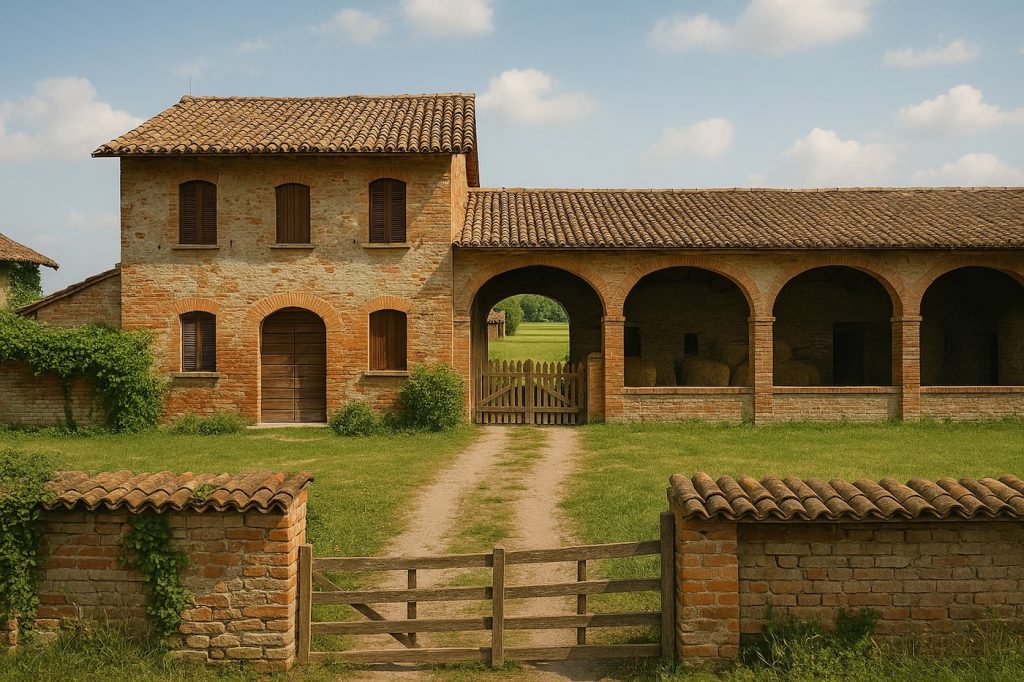
Between the 15th and 19th centuries, agricultural prosperity influenced distinct housing styles. Lombardy’s “Cascina Lombarda,” characterized by quadrangular brick buildings around spacious courtyards, efficiently housed families, livestock, and crops. Similarly, Sicily’s fortified “Baglio” and Puglia’s “Masseria” adopted robust limestone constructions and defensive designs to withstand regional climates and external threats, now revitalized as picturesque hospitality venues.
Rural Charms: Tuscan Farmhouse and Trullo
The rustic “Casale Toscano”, prevalent from the 16th to 19th centuries, epitomizes central Italian rural life, integrating vaulted stables and olive mills with upper-floor accommodations. Meanwhile, in Puglia’s Valle d’Itria, peasants built charming circular limestone “Trulli” with conical roofs, ingeniously designed without mortar, offering natural thermal comfort now celebrated as idyllic rental retreats.

Urban Evolution: Casa Alta Ligure, Casa di Ringhiera, and Villino Liberty
From the narrow, pastel-colored Ligurian tall houses perfectly adapted to coastal topography to Milan’s communal “Casa di Ringhiera,” featuring balconies doubling as corridors, urban Italy continuously evolved its residential architecture. The early 20th-century “Villino Liberty” introduced Art Nouveau elegance, demonstrating a brief but vibrant phase of organic decorative architecture across burgeoning suburbs.
Modernist Visions: Rationalist Villas and Palazzina Anni Sessanta
Italy embraced Modernism through the 1930s Rationalist Villas, marked by clean lines, open plans, and extensive glazing, epitomized by iconic homes like Giuseppe Terragni’s Villa Bianca. Post-war economic prosperity led to the mass construction of six-story concrete “Palazzine,” which met the urgent demand for urban housing with affordability and practicality.
From inspiration to ownership in rural Italy
Italy’s most iconic homes often rise from countryside settings shaped by history and landscape. Before purchasing a rural property, understand the structural, legal and practical aspects involved.

Contemporary Innovations: Supercondominio, Eco-Friendly Alpine Cabins, and 3D-Printed Homes
Since the late 1980s, Italy has seen the rise of the “Supercondominio,” a gated, amenity-rich community structure that balances privacy and social interaction. Concurrently, the Casa Clima initiative in South Tyrol has pioneered ecological Alpine cabins, merging traditional forms with cutting-edge energy efficiency.
Most recently, Italy steps boldly into the future with 3D-printed concrete homes near Ravenna, highlighting a revolutionary, sustainable construction method that drastically reduces waste and labor, signifying a new chapter in Italian architectural tradition. It’s called Tecla and it has been created by Wasp.
Each Italian house type uniquely encapsulates an era’s lifestyle, culture, and technological advancements, collectively narrating Italy’s enduring architectural legacy—a vibrant tapestry spanning millennia.
Related articles
-
 Investment tips Types of Houses
Most Desirable Property Features and Amenities in the Italian Real Estate Market
10 March 2025
-
 Investment tips Types of Houses
Current Luxury Estate Market in Italy: A Comprehensive Analysis
19 June 2024
-
 Types of Houses
Residential Architecture in Tuscany: Styles and Building Types across History
8 July 2025

